
How to Budget by Paycheck: See Bills Before Payday
Your monthly budget can add up while cash runs short before payday. Build a dated paycheck plan, follow two worked examples, and find a free way to start.

Quick answer
What to know first
Put paychecks and bills in the order money becomes available or leaves. Recalculate after each date; a positive ending balance can still hide a shortfall before payday.
Framework
Start with spendable cash, use actual payment dates, include essentials, then check the lowest balance before committing money to another goal.

Start with money you can actually use today. Put each paycheck, bill, essential expense and planned transfer on the date money becomes available or leaves your account. After every entry, add money in and subtract money out. If the projected balance falls below zero – or below an amount you need to keep aside – before the next payday, adjust the plan before the bill is due. A positive total at the end of the month does not mean every earlier payment is covered.
This is a way to organize decisions, not a prediction of your bank balance. Pay can arrive later than expected, card transactions can settle at different times, and an automatic payment can leave when you are not watching. The Consumer Financial Protection Bureau’s bill calendar likewise puts income dates beside payment dates; its cash-flow budget tool carries one period’s ending balance into the next.
A monthly budget and a paycheck plan answer different questions
A monthly budget asks, "Will income cover planned expenses over the month?" A paycheck plan asks, "Will available cash cover the next payment when it leaves?" You need both when paydays and bill dates do not line up. The free Monthly Margin Calculator helps you estimate the first number. The dated method below helps with the second; you can do it on paper or in a basic spreadsheet.
| Use this view | Question it answers | What it can miss |
|---|---|---|
| Monthly totals | How much income remains after planned expenses? | A bill due before the next paycheck. |
| Dated running balance | What is left after each expected deposit or payment? | A deposit delay, an unlisted expense or a transaction that posts differently. |
Build the plan in six steps
- Choose the period. Start today and extend past at least the next payday and the bills it must cover. If you are paid every two weeks, use actual dates; do not assume every month has exactly two paychecks.
- Write down spendable starting cash. Check the money available in the account you will use. Do not count a pending deposit as available or treat savings already committed to another bill as spare cash. The CFPB warns that a deposit may not be available immediately and that a displayed balance does not replace checking available funds. CFPB: What is an overdraft?
- Add each expected payday. Use a take-home amount you reasonably expect and the date the funds should be usable. If pay varies, make a conservative version as well. If the date or amount is uncertain, label it uncertain rather than using it to justify a bill due earlier.
- List payments by the date cash leaves. Include rent, utilities, minimum debt payments, subscriptions and automatic drafts. A due date is not always the same as the date you must initiate payment. The CFPB’s bill calendar calls for recording the date a payment must be sent or taken out, not just its formal due date. If a deposit and payment share a date, verify which will be available first; otherwise test the more cautious order. CFPB bill calendar
- Add daily essentials and planned transfers. Budget groceries and transport between paydays, not only fixed bills. Include a transfer to an irregular-bill reserve as money out if it leaves this cash pool. Do not subtract that transfer and later subtract the same purchase from the same pool without also accounting for money moved back. For reserve math, see How to Budget for Irregular Expenses.
- Recalculate after each line. New balance = previous balance + available money in – money out. Circle the lowest point, not only the ending number. Compare it with any keep-aside amount you chose. That amount is a personal planning guardrail, not a universal rule.
Example 1: the listed period ends well, but the week before payday is tighter
This fictional October 1-16 excerpt is the worked example included in HonestPocket’s spreadsheet. It starts with $300 of available cash, a chosen $100 keep-aside amount and two $1,500 take-home paychecks. The dates and spending are illustrations, not suggested amounts for your household.
| Date | Event | Money in | Money out | Planned balance |
|---|---|---|---|---|
| Opening | Available cash | – | – | $300 |
| Oct. 1 | Take-home pay | $1,500 | – | $1,800 |
| Oct. 2 | Rent | – | $1,000 | $800 |
| Oct. 5 | Groceries and transport | – | $220 | $580 |
| Oct. 8 | Irregular-bill reserve | – | $125 | $455 |
| Oct. 15 | Take-home pay | $1,500 | – | $1,955 |
| Oct. 16 | Bills and debt minimums | – | $650 | $1,305 |
Check the listed transactions: $300 opening cash + $3,000 pay – $1,995 out = $1,305 after October 16. The lowest value in this excerpt is the $300 opening balance. The lowest point after the first paycheck and before the second is $455 on October 8. The plan stays above its chosen $100 keep-aside amount through the dates shown, but that October 8 figure gives more useful timing information than the final number alone. A real October plan would also include expected transactions through October 31 and beyond the next payday.
Example 2: a positive ending balance can hide a shortfall
Here is a separate, simplified October 1-23 excerpt. It begins with $200. Two $1,200 deposits and $2,060 in listed outflows leave $540 after October 23 – but the balance dips below zero first. This is not a complete month of household spending.
| Date | Event | Money in | Money out | Planned balance |
|---|---|---|---|---|
| Opening | Available cash | – | – | $200 |
| Oct. 1 | Paycheck | $1,200 | – | $1,400 |
| Oct. 2 | Rent | – | $1,100 | $300 |
| Oct. 5 | Utility bill | – | $250 | $50 |
| Oct. 7 | Groceries and transport | – | $180 | -$130 |
| Oct. 15 | Paycheck | $1,200 | – | $1,070 |
| Oct. 16 | Debt minimum | – | $200 | $870 |
| Oct. 20 | Groceries and transport | – | $250 | $620 |
| Oct. 23 | Phone bill | – | $80 | $540 |
The arithmetic is $200 + $2,400 – $2,060 = $540. The negative $130 on October 7 means the original schedule does not work, even though the ending number is positive. Do not simply let an account overdraw. A CFPB explanation of overdrafts notes that deposits may not be immediately available and an overdraft can carry fees.
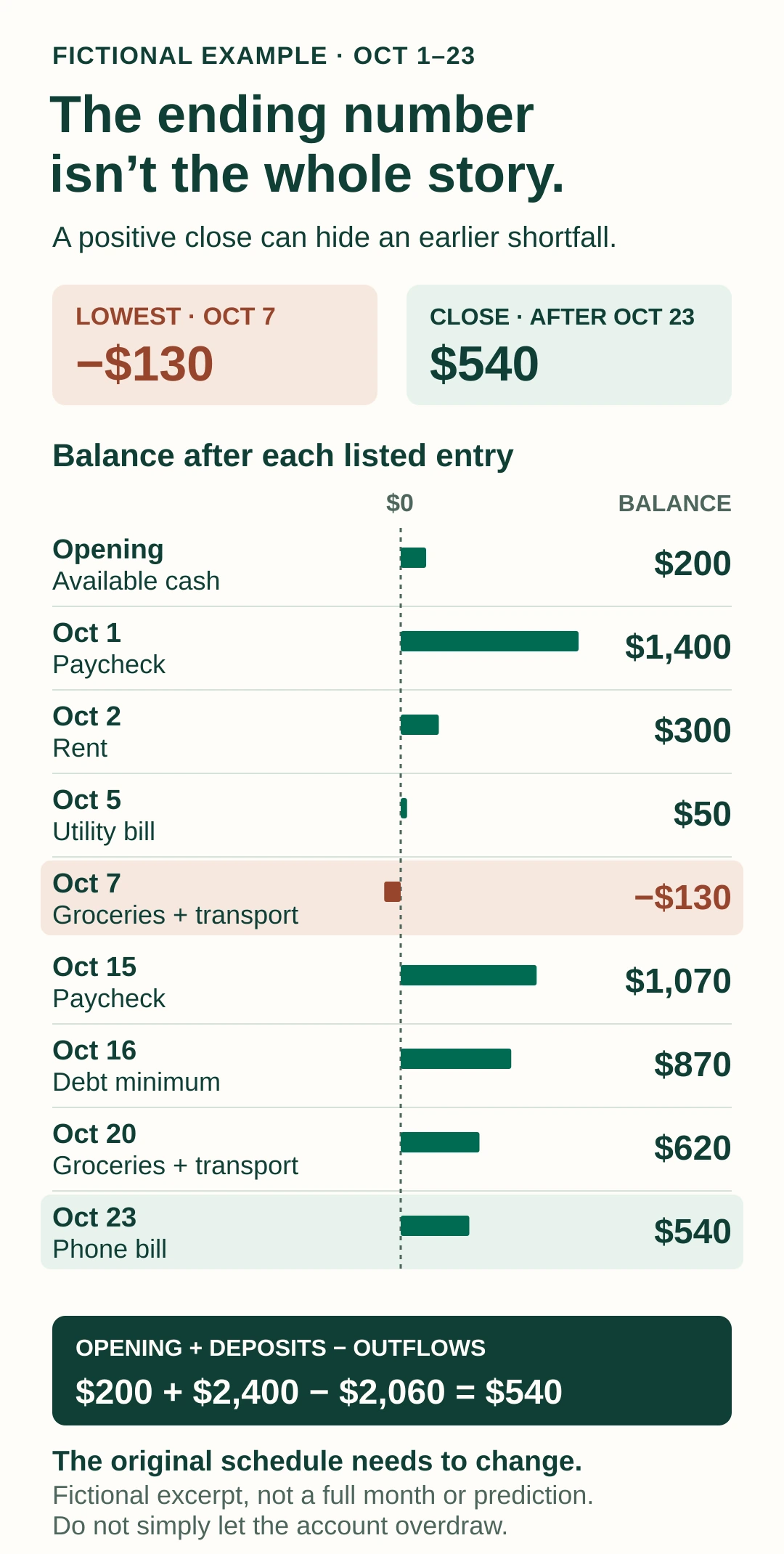
One conditional fix illustrates the value of checking dates: if the utility provider agrees in advance to move its $250 payment from October 5 to October 19, the October 7 balance becomes $120, and the balance after October 23 remains $540. This does not create more income; it changes when cash leaves. Do not assume a due date can be moved or pay late without agreement. The CFPB says some billers may allow a change, but not all do; confirm when the change takes effect, the next bill’s amount and any charges. The first bill after a date change may be higher. CFPB due-date worksheet
When the plan does not work
First check for missing deposits, double-counted reserves, essential costs you understated or automatic payments you forgot. Then contact a biller before the due date if the schedule remains impossible. Ask whether a different due date or payment arrangement is available and what the next payment would cost. Do not mark a later date in your plan until it is confirmed. Where appropriate, review avoidable spending, legitimately available savings or assistance options. If a payment affects housing, utilities or another essential need, seek qualified local help rather than treating a spreadsheet as a substitute for individualized guidance.
Keep checking the account after setting the plan. Automatic debit amounts or timing can differ from what you expect, and too little available cash can lead to overdraft or nonsufficient-funds charges. CFPB: automatic payments
Choose the next tool that fits your problem
- Need a monthly starting number? Use the free Monthly Margin Calculator and review what is already assigned to bills, debt and irregular costs.
- Need a free dated plan? Use paper, a simple spreadsheet or the CFPB’s free bill-calendar worksheet. No purchase is required to use the method in this guide.
- Want a ready-made dated workbook? HonestPocket sells the Paycheck & Bills Planner for $9 once, plus applicable sales tax at checkout. It includes an XLSX cash timeline, irregular-bill rows, a fictional worked example and a four-page printable PDF. It is manual: no bank connection, account sync or reminders. Review the product details and free alternative before deciding.
Choosing between a free calendar, a spreadsheet and an app? See our comparison of tools for bills between paychecks, including costs and the limits of our testing.
If the harder issue is a bill that comes only a few times a year, continue with How to Budget for Irregular Expenses. If you are unsure what money is truly unassigned, read How Much Extra Money Do I Really Have?.
Sources and method
Examples are fictional and calculated line by line from the amounts shown. Example 1 matches the Worked example tab of the HonestPocket Paycheck & Bills Planner version 1.0, September 20, 2026. Example 2 is an independent illustration of timing risk, not a household recommendation. External guidance was checked September 23, 2026 against the CFPB bill calendar, CFPB cash-flow budget, CFPB due-date worksheet, CFPB overdraft explanation and CFPB automatic-payment guidance. This is educational information, not individualized financial advice.
Explore more
Next guides and calculators
Comparison
Tools for Bills Between Paychecks
Compare a free calendar, spreadsheet and app using the same bill-timing question.
Free guide
How to Change Bill Due Dates
Ask about transition payments, keep the current schedule until confirmed and verify autopay.
Free guide
How to Budget for Irregular Expenses
Reserve for nonmonthly bills without counting the same cash twice.
