
How to Budget for Irregular Expenses
Build a realistic budget for annual bills, variable income and savings deadlines, with a worked monthly plan and a payday funding example.

Quick answer
What to know first
Give nonmonthly bills a monthly allowance, then check the actual paydays before each bill is due. Count money already reserved before deciding what is available for another goal.
Framework
List expected costs, calculate the funding gap, check the deadline, then test a lower-income month.

The short answer
List each predictable nonmonthly expense, subtract money already reserved for it, and divide the remaining amount by the paydays before it is due. Include those contributions in your budget alongside normal bills and debt minimums. A yearly average helps with long-term planning; a due-date calculation tells you what you need to set aside now.
This guide is for someone whose monthly budget looks workable but keeps getting interrupted by insurance renewals, repairs or seasonal costs. The examples are fictional planning exercises, not spending targets or a judgment about what your household should earn.
Find the costs your monthly view misses
Review several months of statements and the next year’s known renewals. Put annual insurance, registration, school costs, subscriptions and other expected bills on one list. Do not assume last month’s spending represents the whole year. The CFPB recommends checking past spending for less frequent expenses and comparing your budget with what actually remains in your accounts. Source: CFPB spending assessment.
Use three labels: known amount and date; expected expense with an uncertain amount; genuinely unplanned event. A scheduled $600 premium belongs in the first group. Routine maintenance may need an estimate. An unexpected interruption to income belongs in your emergency planning, not in an artificially precise monthly category.
You do not need a separate bank account for every label. A spreadsheet, notebook or savings category can work if the total assigned money never exceeds the money you actually have. Keep account numbers and other sensitive information out of any worksheet you share.
Build a monthly plan without counting money twice
Here is an example with $4,200 in monthly take-home pay. The household’s essential spending already includes housing, food, transport and insurance paid monthly. Its separate debt-minimum row includes only payments not already counted there.
| Item | Monthly amount | How it was counted |
|---|---|---|
| Take-home income | $4,200 | After payroll deductions |
| Regular essentials | $2,750 | Current realistic spending |
| Debt minimums | $250 | Not included in essentials |
| Annual insurance | $150 | $1,800 divided by 12 |
| Maintenance reserve | $50 | $600 divided by 12 |
| Annual renewals | $30 | $360 divided by 12 |
| Operating buffer contribution | $120 | A separate planning allowance |
| Unassigned monthly margin | $850 | $4,200 minus $3,350 |
The $850 is not automatically spending money. It is the amount left to assign among goals, extra debt payments, additional savings and discretionary spending. A goal contribution already included in another row must not be subtracted again.
Also distinguish a savings transfer from the later purchase it funds. In this contribution-based budget, you reserve $150 each month for insurance. When the premium is paid from that reserve, do not deduct another $1,800 from the same month’s unassigned margin. Your account ledger still records the withdrawal; your allocation plan recognizes that the money already had a job.
Check the due date, not just the annual average
An annual average is not enough when a bill is close. Suppose a $1,200 bill is due after six remaining paydays and you have already reserved $300. The shortfall is $900. Saving $150 on each of those six paydays funds the bill, assuming no price change or interest.
Contribution per payday = (amount due minus amount already reserved) divided by remaining paydays.
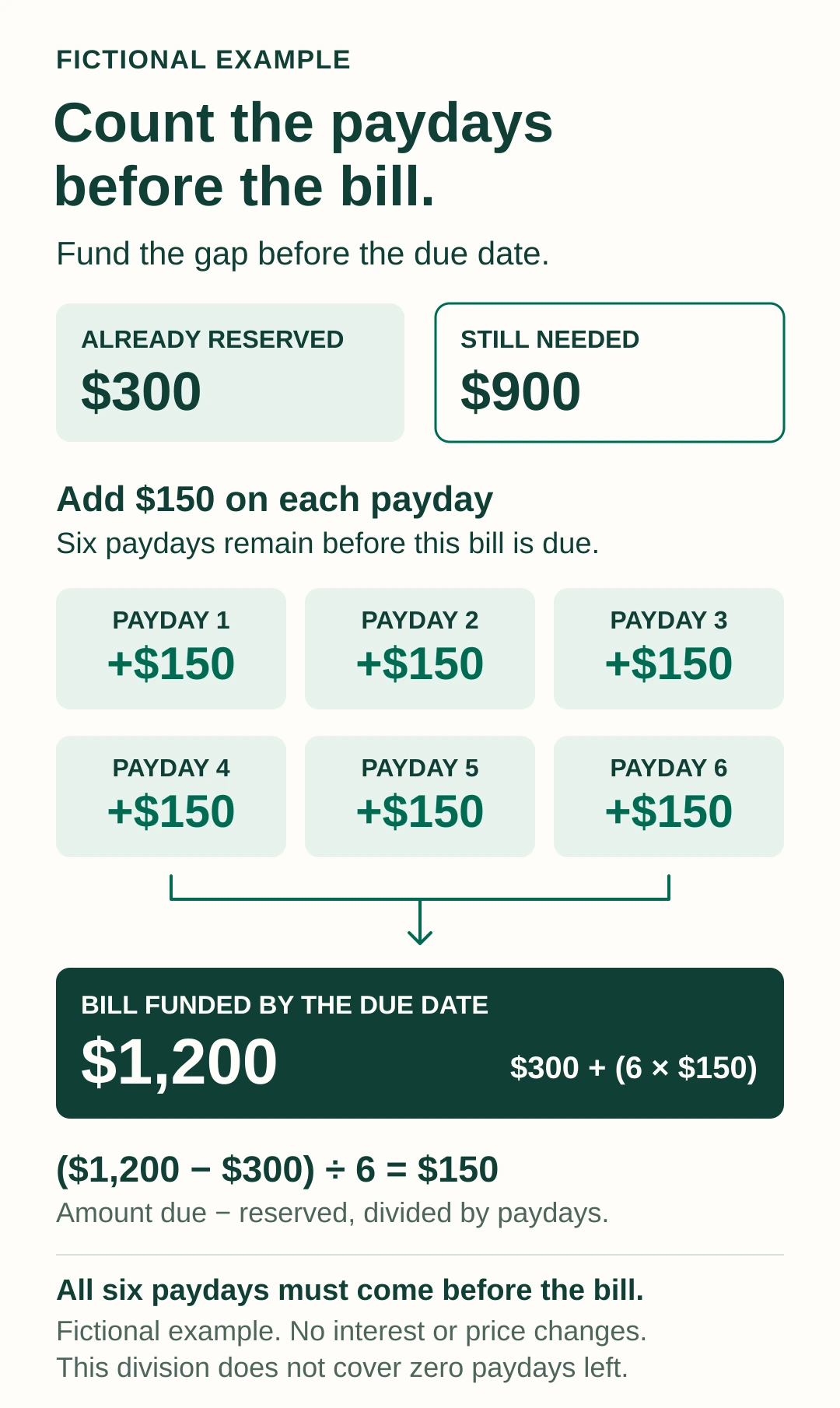
If the amount already reserved covers the bill, the additional contribution needed is $0. If no paydays remain before the deadline, do not divide by zero or assume a future paycheck will arrive in time. Compare the amount due with cash available now and contact the biller promptly about any shortfall or payment options.
Count actual paydays before the deadline. If a bill is due before your sixth paycheck arrives, the example’s plan is too late. When the required contribution does not fit, the problem is a timing or affordability gap, not a failure of willpower. Review the bill, timing, other allocations and available payment options before assuming a credit card is the only answer.
Stress-test a lower-income month
For variable income, write down both an ordinary-month plan and a lower-month scenario. Do not commit a strong month’s pay before it arrives. In the example above, take-home pay of $3,300 produces a $50 shortfall against $3,350 of planned allocations. Knowing that in advance lets the household identify which discretionary goals can wait and whether it needs a larger income-smoothing reserve.
This is a scenario, not a forecast or a rule that your lowest historical month must determine every decision. Seasonal workers, self-employed people and households facing a permanent income change may need a different plan. If income is before taxes or business expenses, do not treat the full amount as household take-home pay.
Then put bills and expected income on a weekly calendar. A positive monthly total can still hide a shortage before payday. The CFPB’s cash-flow budget worksheet focuses on that timing problem.
If a ready-made layout would help, our Paycheck & Bills Planner ($9) includes a date-by-date XLSX cash timeline, space for irregular bills, and a four-page printable PDF. It is optional; a notebook or the CFPB worksheet linked above can also help you map bill timing.
Use the number for one next decision
Use the Monthly Margin Calculator to check your total. Its monthly result does not replace your bill calendar. Keep the nonmonthly-expense list nearby so that your inputs reflect the costs you have just found.
- If the margin is negative, identify which obligations are due first and review realistic assistance or payment options before adding new savings commitments.
- If it is small, choose one manageable next step instead of funding every goal at once.
- If it is stable, decide how much goes to a cash reserve, extra debt payments and other goals.
For the next decision, read Should I Pay Off Debt or Save First? Do not automate a transfer until you have checked the balance and timing needed for upcoming bills.
Your monthly check-in
- Compare planned contributions with actual costs and update changed renewals.
- Check that reserved balances still add up to real cash; an account balance is not the same as unassigned money.
- Look ahead to the next two paydays and one major nonmonthly bill.
- Adjust the plan without treating an estimate that changed as a personal failure.
Educational note: This is general budgeting education, not individualized financial, tax or legal advice. Examples ignore interest and assume the stated income, expenses and deadlines.
Explore more
Next guides and calculators
Topic hub
Saving & Cash Management
Browse the hub for emergency funds, cash flow, and saving systems.
Calculator
Emergency Fund Calculator
Turn the article guidance into a rough target range.
Calculator
Monthly Margin Calculator
Check how much real monthly room you have to build savings.
