
How to Change Bill Due Dates to Match Your Paychecks
Learn how to ask for a bill due date that fits your paychecks, confirm transition payments, and check autopay before the new schedule starts.

Before you change a due date
What to know first
Ask the biller whether a date change is available and how the transition works. Keep paying on the current schedule until the change is confirmed, then verify the first new payment and any autopay instructions.
Framework
Choose a date your available pay can support. Record the old payment still due, the first new payment, any charges and the confirmed autopay schedule before changing your plan.
Your phone bill lands just before payday, when rent and groceries have already taken most of your money. Moving that bill might help. The catch is getting through the change without overlooking a payment that’s still due.
You can ask a biller to move your due date, but keep following your current statement until it confirms a different schedule. Start with one bill, choose a date your paycheck can actually support, and get the transition details before changing your payment plan.
Choose a date that leaves enough for the rest of the pay period
Look at your next two paychecks and the money already committed from each. Include groceries, transportation and other everyday spending. A paycheck with fewer bills may still have plenty of work to do.
Pick a bill that repeatedly squeezes the tighter period. Then check three dates:
- When your pay is available to spend, rather than just showing as pending
- When money would leave your bank account
- When the biller needs to receive your payment
Those dates may differ. A bill due on the 24th doesn’t help if its automatic withdrawal happens before your paycheck is available on the 20th. Ask about withdrawal timing and payment-processing time; leave room for weekends and holidays rather than relying on a same-day deposit and debit.
Paid every two weeks? Check several upcoming months. Your paydays move around the monthly calendar. One fixed due date won’t always fall the same number of days after payday.
For help laying out the dates, use our free budget-by-paycheck guide. You can make this request with a paper calendar and your statements.
Check what your biller actually allows
Look in the billing settings of its official website or app, or contact support using the details on your statement. Ask which dates are available and whether your account qualifies.
Policies vary. As checked on October 2, 2026:
- Capital One says eligible credit-card due-date changes take effect within two billing cycles. Until then, the statement’s due date still applies.
- DISH requires a zero account balance, says a change takes two billing cycles, and warns that the transition bill may be higher or lower.
These are examples, not promises about your account. The CFPB’s due-date worksheet also notes that some companies won’t allow a change.
Use a short request and get specific answers
Here’s a phone or chat script you can adapt:
“Hi, my bill is due on the [current date], and my pay is available on the [payday]. Could you move my monthly due date to the [requested date]? Before I make the change, please confirm what I still need to pay under the current schedule and the first payment under the new one.”
Then ask:
- What are the exact date and amount of my next payment?
- Which bill will first use the new date?
- Will the change add fees, interest or other charges, or change the first bill’s amount?
- What happens to my existing automatic or scheduled payment?
Save the confirmation or chat transcript. Write down the old payment still required and the first new payment separately. If the answers aren’t clear, keep the existing schedule and ask for clarification.
Plan the transition before spending the difference
A later date can make this month’s bank balance look better while the bill is still waiting. Keep that money assigned until you know exactly when it will leave.
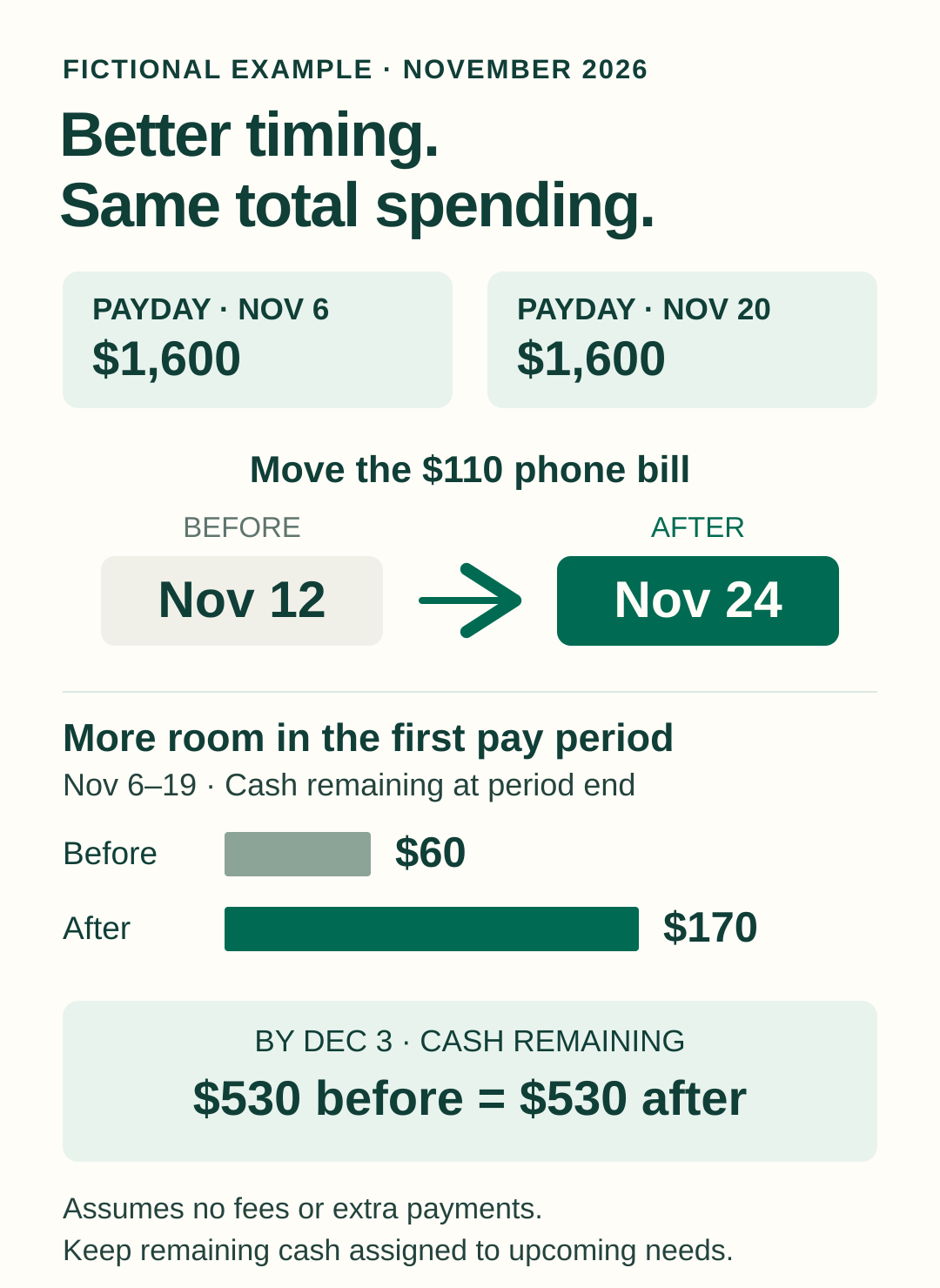
Here’s a fictional example using November 2026. You receive $1,600 on November 6 and another $1,600 on November 20. You start with $100. Under this fictional rental agreement, $1,100 rent is due November 8; the next rent payment is December 8, after a December 4 paycheck. Other bills total $700, all due in the second pay period, and groceries and transportation cost $430 in each pay period. A $110 phone bill moves from November 12 to November 24.
For this example, the provider confirms that the October 12 payment still goes ahead. It’s paid before the $100 opening balance on November 6, outside this table. November 24 replaces November 12, the November bill stays $110, and there are no fees or extra payments. Your own confirmation may be different.
| Plan and pay period | Bills paid | Everyday spending | Cash remaining |
|---|---|---|---|
| Before change · Nov 6–19 | $1,210 | $430 | $60 |
| Before change · Nov 20–Dec 3 | $700 | $430 | $530 |
| After change · Nov 6–19 | $1,100 | $430 | $170 |
| After change · Nov 20–Dec 3 | $810 | $430 | $530 |
The first period starts with $1,700. Each second period carries forward the first period’s remaining cash and adds the next $1,600 paycheck. All listed spending is paid within its period; the table shows period-end cash, not the lowest daily balance.
Moving the phone bill leaves $110 more available during the first period. The final $530 is unchanged because the same bill is paid once in both plans. Keep that $530 assigned to upcoming needs. If a transition charge applies, subtract it too.
Check autopay in the place that controls it
Don’t assume a new due date updates every payment instruction.
- If the biller takes money from your account, check its next scheduled withdrawal date and amount.
- If your bank sends the payment through bill pay, check that bank’s schedule and delivery estimate separately.
- If you’ve already arranged a one-time payment, confirm whether it remains queued before creating another.
The CFPB explains the difference between automatic debits and bank bill pay. It also recommends checking that transfers match the timing and amounts you agreed to.
Put a reminder ahead of the first changed withdrawal. Make sure the money is available, then verify that the payment processed and the biller credited it. A confirmation of the date change isn’t confirmation that the bill was paid.
If the answer is no
Ask whether another available date would work. Otherwise, reserve money from an earlier paycheck or, if the biller’s rules allow, pay early. Only split a payment after confirming the arrangement satisfies the biller’s requirements.
If your income won’t cover the bills and essentials across the whole month, moving dates won’t close that gap. Contact the biller before the deadline about hardship options or an agreed payment arrangement. Don’t treat an unanswered request as permission to delay.
For today, choose one awkwardly timed bill and write down the due date you’d like to request.
Explore more
Next guides and calculators
Free guide
Budget by Paycheck
Put paydays and bills in date order and check the balance before each payment.
Comparison
Tools for Bills Between Paychecks
Compare a free calendar, spreadsheet and app using the same bill-timing question.
Free guide
How to Budget for Irregular Expenses
Reserve for nonmonthly bills without counting the same cash twice.
