
On this pageTable of contents
- First, separate the mortgage from the housing budget
- Buying a home: collect five numbers
- A worked example: the payment is not just $2,023
- Already have a mortgage? Start with your statement
- What does an extra $200 a month change?
- Before paying extra, check these tradeoffs
- Common mortgage planning questions
- Your next step
How Mortgage Payments Work and What Paying Extra Changes
Understand principal, interest and housing costs. Compare extra-payment savings and learn what to check before paying your mortgage off sooner.

Understand the full payment
What to know first
Separate principal and interest from taxes, insurance and other ownership costs. For an existing loan, use the current statement balance. Extra principal can shorten payoff without lowering the required monthly payment.
Framework
Build a realistic baseline, protect your cash buffer, then change one assumption at a time. Confirm extra-principal instructions and payoff amounts with your servicer.

First, separate the mortgage from the housing budget
A listing might show a payment that looks manageable. Before treating that number as your budget, find out what it includes. Put each cost into one of these groups:
- Principal: the part that reduces the loan balance.
- Interest: the cost of borrowing the money.
- Property taxes and home insurance: recurring ownership costs that may be collected through escrow or paid separately.
- Mortgage insurance and HOA dues: additional costs if they apply to your loan or property.
- The rest of homeownership: repairs, maintenance, utilities, moving expenses, and cash needed at closing.
The calculator adds the first four groups to estimate a monthly housing cost. It does not assume that a zero in an optional field means the expense will not exist. The last group needs a separate budget.
For a lender’s specific offer, read the Loan Estimate. Compare the loan terms, projected payments, closing costs, and cash-to-close details. Two offers with similar monthly payments can have different upfront costs.
Buying a home: collect five numbers
- Home price. Use a price you are considering, not the highest amount you might qualify to borrow.
- Down payment. Subtract it from the price to find the starting loan amount. Keep moving costs, closing cash, and reserves outside that down-payment number.
- Note interest rate. This is the rate used to calculate loan interest. APR incorporates additional borrowing costs and is useful for comparing offers, but it is not the number to substitute into the monthly interest calculation.
- Term. Compare the payment required over 15 versus 30 years without assuming you will qualify for the same rate on both.
- Property-specific costs. Ask about taxes after purchase, insurance, association dues, and mortgage insurance. A seller’s old tax bill or someone else’s insurance premium may not match yours.
The weekly benchmark in the calculator is a starting reference. Freddie Mac’s PMMS reports national weekly mortgage averages for a defined loan sample, not personalized approvals or a locked rate. We show the date beside the number. You can enter a quote instead, and your custom rate takes priority.
A worked example: the payment is not just $2,023
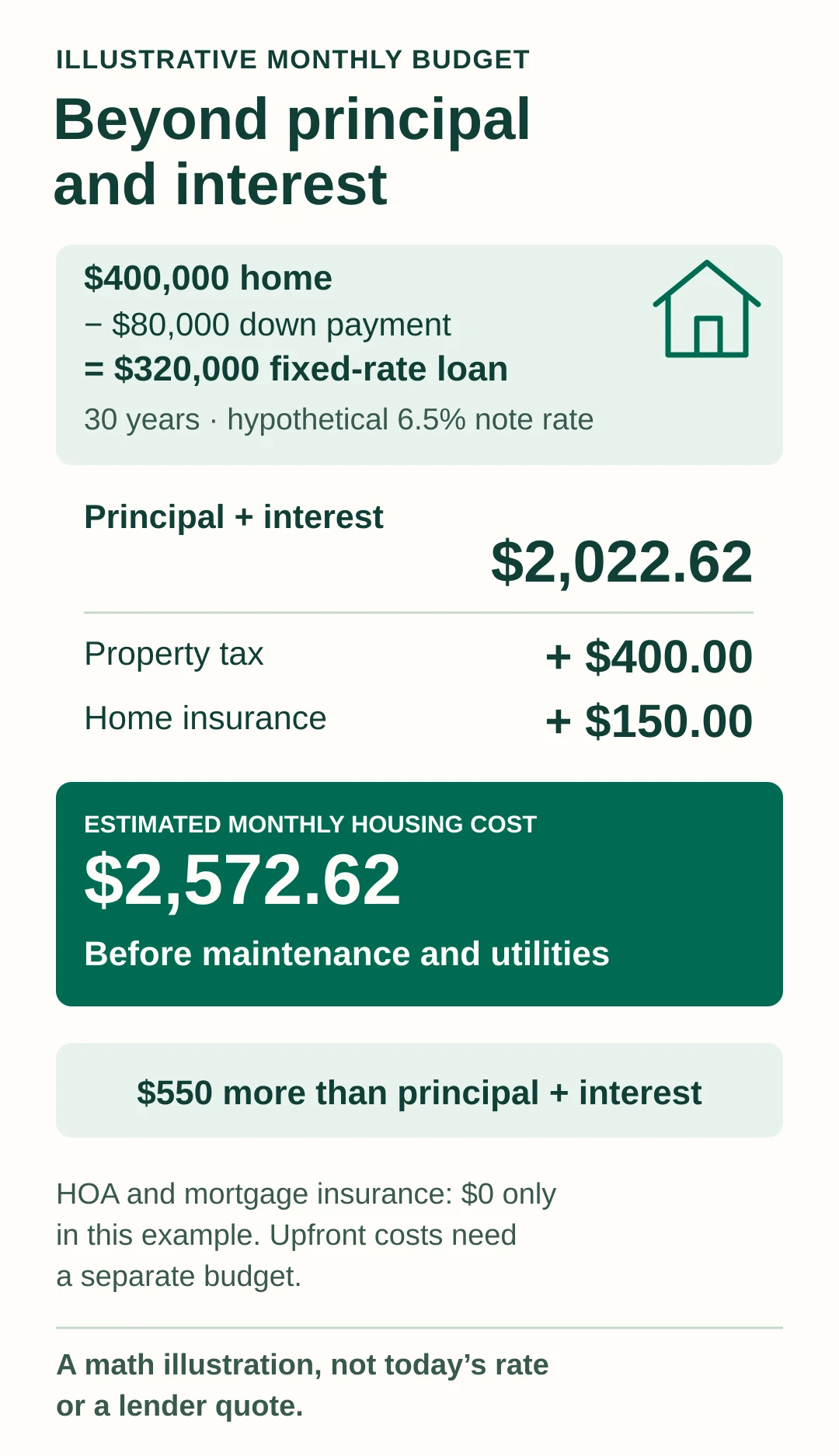
Suppose a home costs $400,000, with $80,000 down and a $320,000 fixed-rate loan. Use an illustrative 6.5% annual rate over 30 years. This is a math example, not today’s rate or a lender offer.
| Cost | Monthly amount |
|---|---|
| Principal and interest | $2,022.62 |
| Property tax: $4,800 per year | $400.00 |
| Home insurance: $1,800 per year | $150.00 |
| HOA and mortgage insurance in this example | $0.00 |
| Estimated monthly housing cost | $2,572.62 |
That is $550 more each month than principal and interest alone, before maintenance or utilities. A buyer planning only around the headline loan payment would miss a meaningful part of the budget.
With a smaller down payment on a conventional loan, private mortgage insurance may apply. PMI protects the lender, not the homeowner. Its amount and payment structure vary. Enter the lender’s estimate rather than assuming a generic percentage. FHA, VA, and other loan programs have their own fee and insurance rules; this tool is not a substitute for a program-specific quote.
Already have a mortgage? Start with your statement
Choose the existing-homeowner mode and enter the current unpaid principal, your note rate, and the required monthly principal-and-interest amount. Do not enter the original loan amount or the total automatic bank withdrawal if that withdrawal includes escrow.
For example, a $2,100 withdrawal might include $1,600 of principal and interest and $500 for taxes and insurance. Entering all $2,100 as the loan payment would make the calculator predict an unrealistically early payoff.
The result estimates a timeline from the first or next payment month you choose. It cannot know whether your account has late fees, past-due interest, a modification, or payments awaiting processing. Ask your servicer for the exact balance and a dated payoff quote when you actually plan to close the loan.
What does an extra $200 a month change?
Return to the illustrative $320,000 loan at 6.5%. Keep its regular $2,022.62 principal-and-interest payment and add $200 to principal each month, beginning with the first payment.
| Plan | Time to payoff | Total interest |
|---|---|---|
| Regular payment | 360 months | $408,140.64 |
| With $200 extra monthly | 281 months | $302,712.79 |
In this example, that is 79 months sooner and $105,427.85 less interest. The larger result is not a promise: it assumes the same fixed rate, on-time monthly payments, no fees, and consistent extra principal. Monthly interest is rounded to cents and the last payment clears the remaining balance; your servicer’s rounding may differ.
An extra payment lowers the balance on which future interest is calculated. That is why timing matters. A lump sum early in the loan generally has longer to affect future interest than the same amount near the end. The calculator lets you choose which payment month receives the lump sum.
Before paying extra, check these tradeoffs
- Keep usable cash. Money paid into the house is not the same as cash available for a repair or an income interruption.
- Look at other debt. A higher-rate balance may deserve attention before a lower-rate mortgage. Compare the actual rates and required payments.
- Check your instructions. Confirm how the servicer applies additional principal. Do not assume an extra transfer automatically does what you intend.
- Read your loan terms. Some mortgages have prepayment penalties. Small extra-principal payments often do not trigger them, but verify your own contract with the lender. CFPB explains the distinction.
- Keep the comparison fair. Do not present uncertain investment returns as guaranteed alternatives to interest saved. Liquidity, risk, taxes, and personal priorities all matter.
If your budget feels tight, use the Monthly Margin Calculator first. Then build an emergency-fund target that fits the household before committing every spare dollar to the mortgage.
Common mortgage planning questions
Will extra principal lower next month’s required payment?
Not in this model. The regular payment stays the same while the payoff date moves earlier. A lender-approved recast may change a required payment; refinancing replaces the loan with different terms and costs. Neither is automatically created by making an extra payment.
Does this tell me how much house I can afford?
It estimates a payment, not affordability or approval. Put the estimated cost into your whole budget, including irregular expenses and reserves. A lender’s borrowing limit and a comfortable household budget are different questions.
Can I use a Zillow listing?
You can enter a home’s asking price and verify its other costs independently. The calculator does not import listings or verify a property’s taxes, valuation, or loan eligibility. A listing estimate is not a lender quote.
Why does the calculator reject a very low payment?
If a payment does not cover the month’s interest, the usual declining-balance payoff calculation does not work. Check that you entered the correct principal-and-interest amount. The tool also stops timelines beyond 50 years instead of suggesting the loan has a normal payoff.
Your next step
Make one realistic baseline estimate, then change one input at a time: price, down payment, term, or extra principal. Save the schedule and write down the assumptions. Take those questions to your lender or servicer before acting.
By Yasmany Perez. Educational information, not individualized financial, tax, or legal advice. Examples are calculated with the HonestPocket mortgage model and do not represent a loan offer.
Explore more
Next guides and calculators
Topic hub
Debt & Credit
Browse the hub for payoff strategy, utilization, and credit basics.
Calculator
Debt Payoff Calculator
Model payoff timelines and compare the cost of different approaches.
Calculator
Debt or Emergency Fund First Calculator
Compare debt payoff urgency against the need for a starter cushion.
