
Investment Account vs. Investment: A Beginner’s Guide
Understand the difference between an IRA, brokerage account and the investments inside them, with a practical checklist before you fund an account.

Account or investment?
What to know first
An account holds your money and investments under a set of rules. An investment is what you own inside it. Funding an account does not necessarily mean you have bought an investment.
Framework
Name the goal, understand the account rules, choose appropriate holdings, then verify what happened after funding.

You open an investing app and see “Roth IRA,” “brokerage account,” “index fund” and “ETF.” They look like competing choices. They are not all the same kind of thing. Sorting out the account from the investment makes the rest of the decision much easier.
What is an investment account?
An investment account is an account used to hold cash and investments, such as stocks, bonds or funds. It is the account that holds your investments, not an investment itself. Account types can differ in their services, fees and tax treatment; the SEC’s investment-account overview explains the main categories.
Retirement account vs. investment account
A retirement account is a type of investment account, not its opposite. An IRA or 401(k) has retirement-specific rules and tax treatment. A taxable brokerage account is another type of investment account. The account and the investments inside it are still two separate choices.
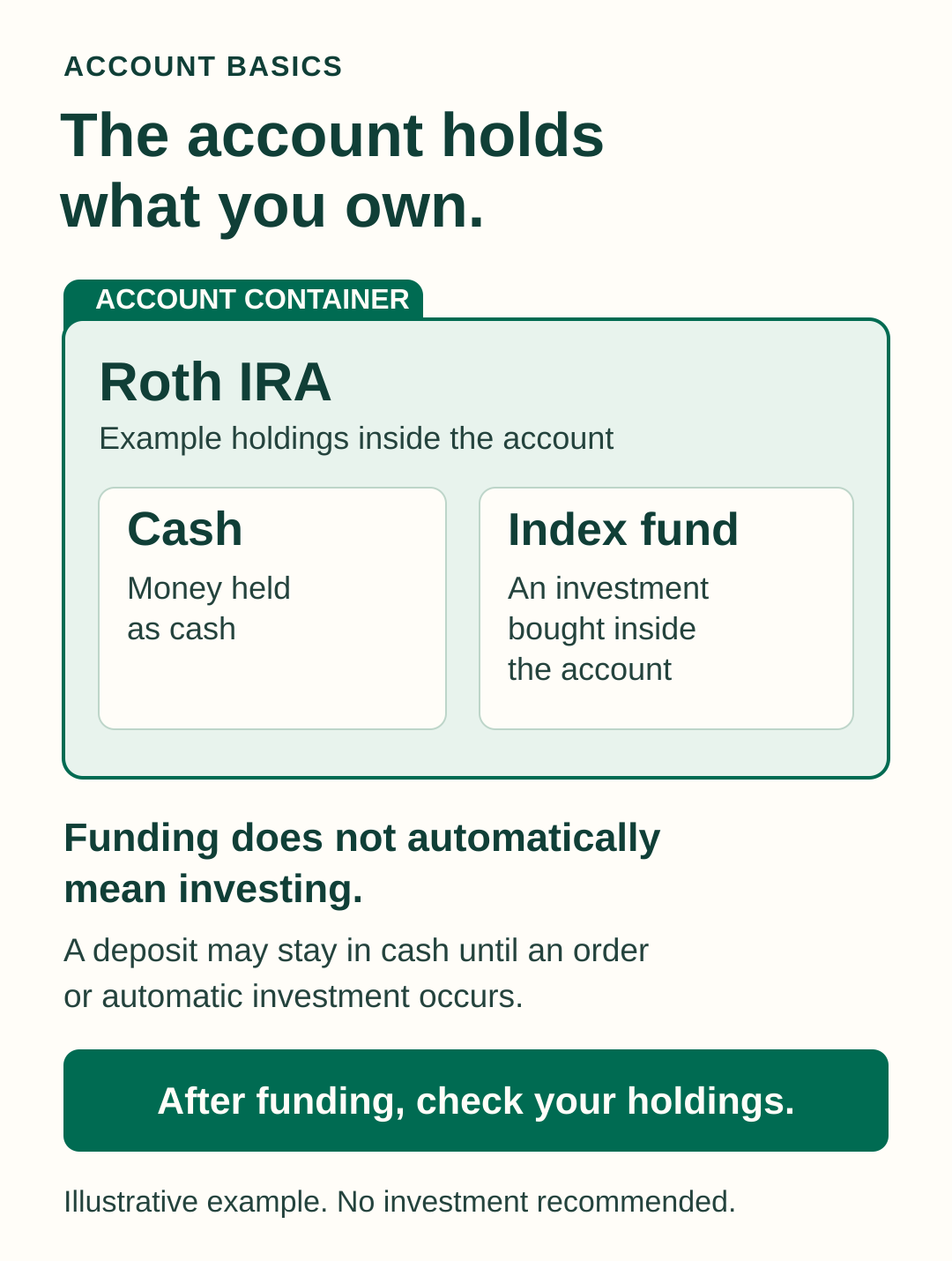
Example: a Roth IRA is the account; an index fund bought inside it is the investment. Opening or funding the IRA does not, by itself, tell you what you own. Check the holdings and activity to see whether the money is invested or still held as cash.
Separate the two decisions
Start with two questions: What is this money for? What do I want to own? The first helps you consider the account. The second helps you consider investments. Neither question can be answered by the color of an app’s “Get started” button.
Imagine two labels on a folder. The outside label says “retirement.” Inside is a list of holdings. Changing the folder label does not magically change the risk of those holdings. A stock fund can lose value whether you hold it in a retirement account or elsewhere.
A practical note: write your goal and expected spending date before comparing providers. “Money I might need for rent” and “money for retirement decades away” are not interchangeable goals.
Three account types beginners encounter
Workplace retirement plan
A 401(k) or similar plan is arranged through an employer. Investment choices and fees depend on that plan. Some employers offer matching contributions, but the formula, eligibility and ownership rules can differ. The Department of Labor’s retirement-plan guide explains why the plan documents and vesting schedule matter.
Before opening a second account, locate your current plan summary. Write down the match, the investments you currently own and the fees you can identify. If you cannot find an answer, ask the plan administrator a specific question rather than assuming an online example applies.
Individual retirement account
An IRA is an individual retirement arrangement, not a specific stock or fund. Traditional and Roth IRAs have different tax treatment. A traditional IRA contribution may be deductible; Roth contributions are not. Qualified Roth distributions can be tax-free. Eligibility, contribution and withdrawal conditions matter, so neither is automatically the better choice.
Use the IRS traditional and Roth IRA overview when checking current rules. This guide intentionally does not give a contribution limit that could become outdated or overlook your circumstances.
Taxable brokerage account
A brokerage account outside a retirement arrangement can hold investments without being an IRA. Dividends, interest and realized gains can have tax consequences. “Taxable” does not mean every withdrawal is taxed in the same way; the type of income, transactions and your circumstances matter.
Also distinguish a cash brokerage account from a margin account. A cash account requires you to pay for purchases in full; margin involves borrowing and adds risks, including possible forced sales. See the SEC’s explanation of brokerage account types. Do not accept borrowing features simply because they appear during signup.
Funding the account is not always the final step
Consider Jordan, who transfers $500 into an account intended for retirement. That transfer answers “Where is the cash?” It may not answer “What investment do I own?” Depending on the account and its instructions, the money might remain in a cash position until an order or automatic investment occurs.
After funding, inspect the holdings and activity screens. Look for the investment name, amount or shares, order status, remaining cash and any recurring-investment instruction. A deposit confirmation is not the same document as a completed trade confirmation.
This is an illustrative workflow, not a recommendation to invest $500 or to choose a particular investment. The useful habit is verifying what happened instead of relying on what you intended.
Compare providers after you know the job
Create a short comparison note for two or three providers that offer the account you actually need. Check the complete fee schedule, available investments, minimums, cash handling, recurring-purchase options and access to support. A headline advertising commission-free trades is not proof that every service or investment is free.
The SEC’s brokerage account opening bulletin is a useful checklist. Confirm the provider’s identity and understand what agreements you are signing. Be cautious with an unsolicited link promising an unusually easy return.
A reader-fit comparison should explain who a provider does not suit. For example, someone making small regular purchases might care about investment minimums and recurring-purchase support more than an advanced trading screen. These are evaluation questions, not an endorsement of a provider.
Your five-minute preparation note
- My goal is ___, and I expect to need this money around ___.
- The account I am considering is ___ because ___.
- The investment or cash position I would hold is ___.
- The fees and rules I still need to verify are ___.
- After funding, I will check ___ to confirm what I own.
If you cannot comfortably separate the money from upcoming bills, pause account shopping and complete the Money Clarity Reset. If the account choices make sense but funds still feel confusing, use the fund basics section next.
Educational information for U.S. readers, not personalized investment, tax or legal advice. Investments can lose value. Examples are hypothetical; no provider or investment is recommended. Sources checked September 8, 2026. Editorial standards · Affiliate disclosure.
Explore more
Next guides and calculators
Topic hub
Investing
See the investing explainers that fit once your money basics are stable.
Roadmap
Start Here
Use the roadmap if you need to confirm investing is the right next step.
Tools
Tools
Jump to the calculators that support the next decision with numbers.
