
Debt Snowball vs. Avalanche: A Worked Comparison
Compare payoff order, interest cost and early milestones using the same two debts and payment, with transparent assumptions and next steps.

Quick answer
What to know first
The avalanche targets interest cost; the snowball targets an early balance payoff. Compare both with the same debts and total payment, after checking that essentials and minimums fit.
Framework
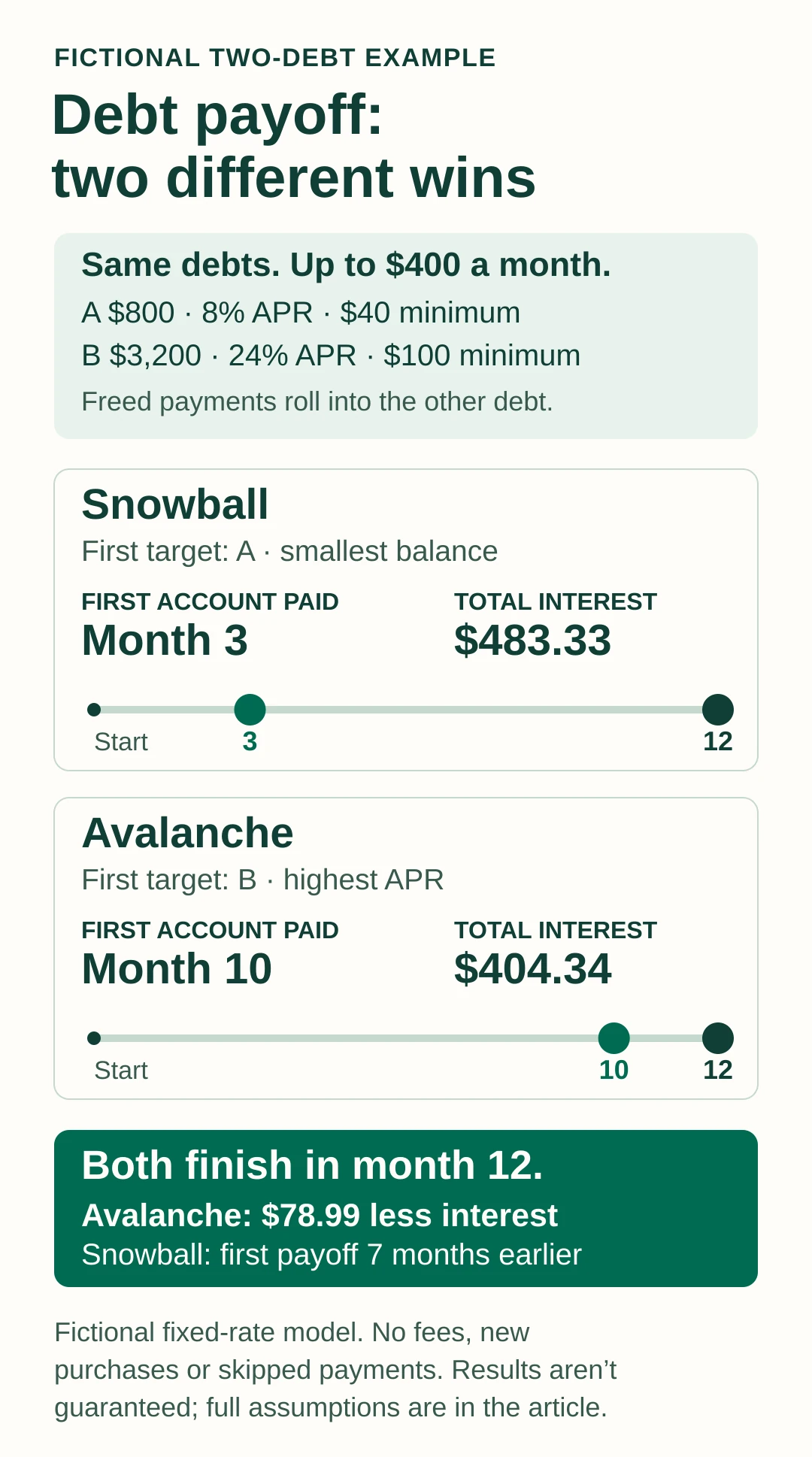
Our two-debt example costs $78.99 less with avalanche; snowball clears its first account seven months earlier. These are modeled results, not guarantees.

Choose the tradeoff, not the slogan
With fixed rates, no special loan conditions and the same payments, directing extra money to the highest-rate debt reduces interest cost. Starting with the smallest balance can produce an earlier payoff milestone. The CFPB describes these two methods and their cost-versus-momentum tradeoff in its reducing debt worksheet.
Neither strategy fixes an unaffordable total payment. This comparison assumes you can cover essentials and the required minimum on every account. If that is not true, start with the help section below rather than choosing a payoff order that your budget cannot support.
The same two debts and the same $400 payment
| Debt | Balance | APR | Assumed minimum |
|---|---|---|---|
| A | $800 | 8% | $40 |
| B | $3,200 | 24% | $100 |
| Total | $4,000 | Two separate rates | $140 |
The household pays up to $400 each month: $140 of assumed minimums plus $260 extra at the start. When one account is paid off, its payment stays in the total and moves to the other debt. The final payment is only the amount still owed.
Our model adds interest at APR divided by 12 before each month’s payment, pays each assumed minimum, then allocates the remainder by the chosen order. Rates and minimum dollar amounts stay fixed. There are no fees, new purchases, promotional expirations, prepayment penalties or skipped payments. Calculations retain precision internally and round the displayed results to cents. Real statements may calculate interest daily and change minimum payments.
What the comparison shows
| Measure | Avalanche | Snowball |
|---|---|---|
| First target | B: 24% APR | A: $800 balance |
| Month 1 payments | A $40; B $360 | A $300; B $100 |
| First account paid off | B in month 10 | A in month 3 |
| All debt paid off | Month 12 | Month 12 |
| Total modeled interest | $404.34 | $483.33 |
| Total paid | $4,404.34 | $4,483.33 |
The avalanche costs $78.99 less in this example. The snowball clears an account seven months earlier. Both finish in month 12, but that does not mean they cost the same. A rounded number of months can hide a different final payment.
These are original scenario calculations, not observed customer outcomes, savings guarantees or forecasts for your accounts. The result does not prove that a particular person will stick with one method. Consistency is a behavioral question this arithmetic cannot measure.
Check the first month yourself
Debt A’s first interest charge is $800 x 0.08 / 12 = about $5.33. Debt B’s is $3,200 x 0.24 / 12 = $64. Both strategies start with the same approximately $69.33 of interest.
After the avalanche payments, balances are approximately $765.33 and $2,904. After the snowball payments, they are approximately $505.33 and $3,164. Next month, interest is calculated on those different remaining balances. That is where payoff order begins changing cost.
The Debt Payoff Calculator estimates one balance at one rate. It is useful for understanding a single debt’s payment, but it does not reproduce this two-account allocation automatically. Do not merge these debts under a guessed average rate and expect the same result.
When the simple ranking is not enough
- Promotional or deferred interest: Read the expiry terms before assuming today’s displayed rate tells the whole story.
- Past-due or secured obligations: Consequences such as loss of essential housing or transport can matter more than a mathematical ranking.
- Payment rules or penalties: Check how extra payments are applied and whether restrictions change the value of paying early.
- Unstable cash flow: An extra payment that forces new borrowing next week may not represent durable progress.
This article compares ordinary payoff ordering, not debt settlement, bankruptcy, student-loan program selection or a personalized legal strategy. Those decisions may need qualified help.
If minimums do not fit
Contact the card issuer promptly, explain the shortfall and ask what hardship or payment arrangements are available. Before using a counseling service, ask about services and fees. Be cautious of promises to make debt disappear or instructions to stop communicating with creditors. Source: CFPB guidance when credit-card bills are unaffordable.
A calculator cannot negotiate with a creditor or guarantee that a proposed payment will be accepted. Write down who you spoke to and request the actual terms of any agreement.
Your first-week checklist
- List balances, current APRs, required minimums, deadlines and unusual terms from your own statements.
- Confirm a total payment that fits after essentials and a realistic cash buffer.
- Pick an order deliberately and keep all required payments in the plan.
- After each payoff, redirect the freed payment if your circumstances still support it.
- Review the plan when rates, income or obligations change.
If you are still deciding whether an extra dollar should go to debt or cash reserves, read Should I Pay Off Debt or Save First? before increasing payments.
Educational note: Examples are simplified and do not replace account disclosures or individualized financial or legal advice.
Explore more
Next guides and calculators
Topic hub
Debt & Credit
Browse the hub for payoff strategy, utilization, and credit basics.
Calculator
Debt Payoff Calculator
Model payoff timelines and compare the cost of different approaches.
Calculator
Debt or Emergency Fund First Calculator
Compare debt payoff urgency against the need for a starter cushion.
