
Emergency Fund vs. Sinking Fund: Give Your Savings a Clear Job
Separate expected bills from financial surprises, avoid counting savings twice and calculate how much emergency cash you actually have.

Quick answer
What to know first
A sinking fund is savings for a planned expense, such as an annual insurance bill. An emergency fund is savings for unplanned costs or income loss. Keep the amounts assigned to each purpose separate so the same money is not counted twice.
Framework
Give each dollar one job. Reconcile reserved amounts with real cash and revise the plan after using savings.

Two reserves, two different jobs
If a bill is likely to arrive and you can estimate its timing, start a sinking fund for it. If the timing or event is genuinely uncertain and it could disrupt essentials, plan for it in emergency savings. These are budgeting labels, not special account types or promises that every expense will fit neatly into one category.
The CFPB describes an emergency reserve as money for unplanned expenses or financial emergencies and emphasizes that an appropriate amount depends on the household. Source: CFPB emergency fund guide. The distinctions and examples below are our planning framework, not an official eligibility test for using your savings.
| Situation | Planning category | Question to ask |
|---|---|---|
| Annual insurance renewal | Sinking fund | How much is due, and when? |
| Routine maintenance | Sinking fund estimate | What is a realistic annual allowance? |
| Unexpected loss of income | Emergency reserve | Which essential costs must continue? |
| Urgent repair above the maintenance reserve | May use both | What is essential now, and what cash is available? |
| Optional trip or upgrade | Planned goal | Can it wait without harming essentials? |
Sinking fund vs. savings: what is the difference?
A sinking fund is a specific use for savings, not a separate kind of account. “Savings” is the broad category: it can include money for planned bills, emergencies and other goals. A savings account is where you may keep that money; a sinking fund describes what part of the balance is for. Whether you use one account or several, track the amount assigned to each purpose.
Count the reserve you actually have
Suppose your savings balance is $5,000. Of that, $1,200 is already assigned to insurance and $600 to a scheduled repair. Your unassigned emergency reserve is $3,200, not $5,000. If essential spending is $2,800 a month, that reserve represents about 1.14 months of those expenses.
$5,000 cash minus $1,800 earmarked for known costs = $3,200 emergency cash.
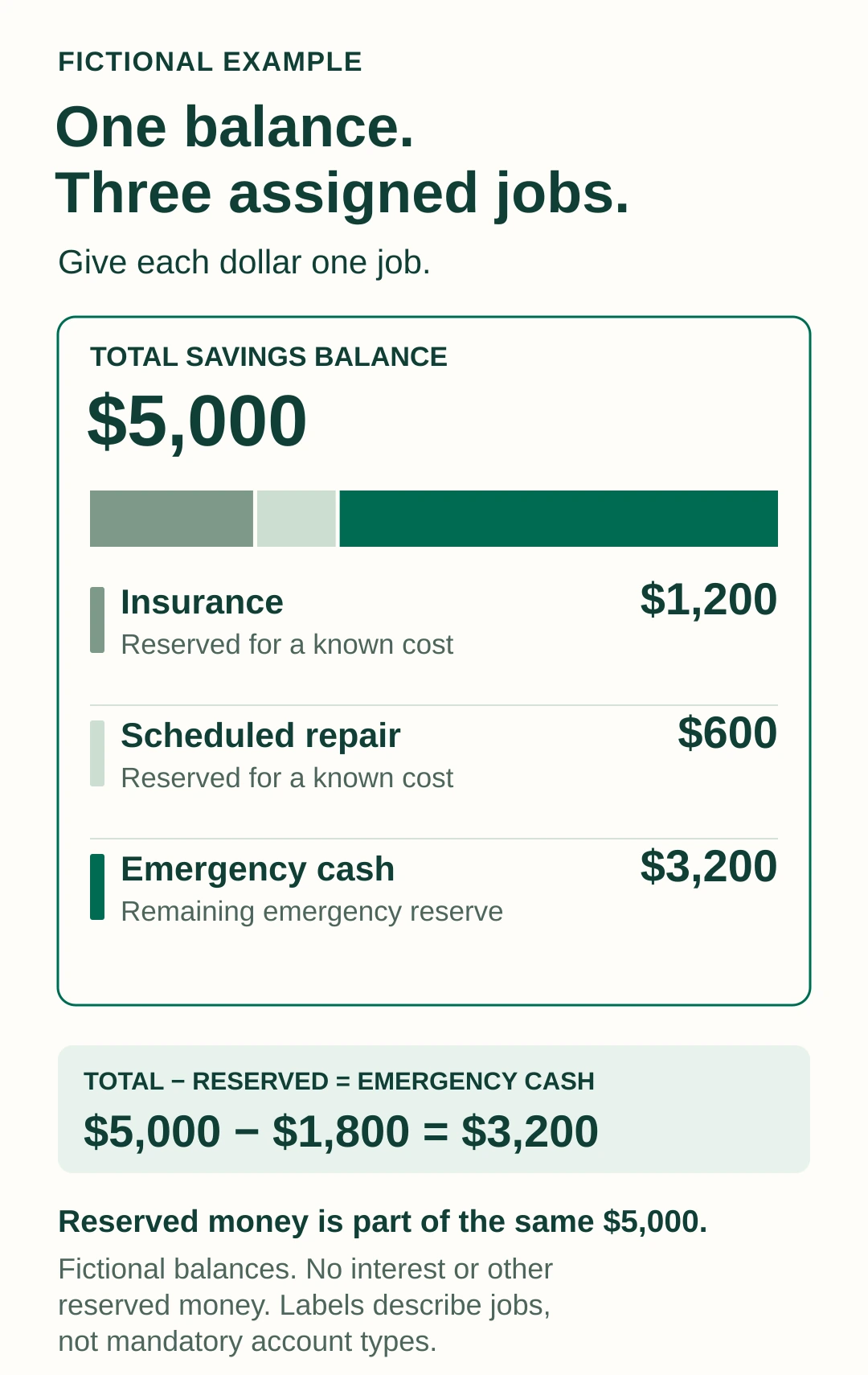
That distinction does not mean you are forbidden to use earmarked money in a crisis. It means using it creates another funding gap. If you move $600 from the repair category to groceries after a lost paycheck, update the repair plan rather than pretending both jobs remain fully funded.
Do not count the same balance as an emergency fund, a down payment and a debt-payoff reserve. Separate accounts can help some people, but clear records in one account can also prevent double-counting. Choose a system you will actually reconcile.
How to fund both without an all-or-nothing rule
Begin with upcoming essentials and required payments. Then identify the next predictable large bill and the cash cushion you have today. If a renewal is due next month, ignoring it while building a long-term reserve can simply turn a known bill into a new borrowing need.
For illustration, a household with $300 of genuinely available monthly margin might assign $150 to a close insurance deadline, $100 to emergency savings and $50 to maintenance. That is an example of fitting a deadline into a budget, not a recommended allocation for every household. A different deadline, debt cost or employment risk changes the decision.
If there is no margin, dividing zero into more categories will not create cash. Review expenses, timing, benefits or hardship options where appropriate. The Monthly Margin Calculator can help identify the gap before you set transfers.
To put planned contributions beside your actual paydays and bills, use a notebook or see the Paycheck & Bills Planner ($9 once, plus applicable tax): a manual XLSX workbook and four-page printable PDF, with no subscription or bank connection.
Choose access and protection before chasing yield
For cash you may need urgently, compare how you can access it, the institution’s deposit-insurance coverage, fees, transfer timing and account restrictions. A high advertised yield is not enough if you cannot reach the money when a bill is due.
A money market fund is an investment, not the same thing as a bank money market deposit account. The SEC notes that money market funds are not FDIC-insured and can lose money. Source: Investor.gov money market funds. Check the actual product rather than relying on a similar name in an app.
For a planned expense with a known date, you can compare additional account options, but check any early-withdrawal conditions before locking up the money. This guide does not recommend a particular bank, investment or deposit term.
After you use a reserve
- Record what was spent and which category paid for it.
- Recalculate the remaining cash available for essential surprises.
- Check whether the expense was actually predictable and deserves a future sinking fund.
- Rebuild at a pace your current income supports. Do not fund a transfer by creating another unpaid essential bill.
If an urgent repair exhausted both categories, focus first on what is due next. The labels are there to improve your decisions, not make necessary spending feel like a mistake.
Set an emergency target separately
Use How Much Emergency Fund Do I Need? to think through household risk, then use the Emergency Fund Calculator with the amount truly available for emergencies. In the example above, enter $3,200 as current emergency savings, not the full $5,000 account balance.
Educational note: The arithmetic uses fictional balances, excludes interest and assumes no other reserved money. This is general financial education, not individualized advice.
Explore more
Next guides and calculators
Topic hub
Saving & Cash Management
Browse the hub for emergency funds, cash flow, and saving systems.
Calculator
Emergency Fund Calculator
Turn the article guidance into a rough target range.
Calculator
Monthly Margin Calculator
Check how much real monthly room you have to build savings.
